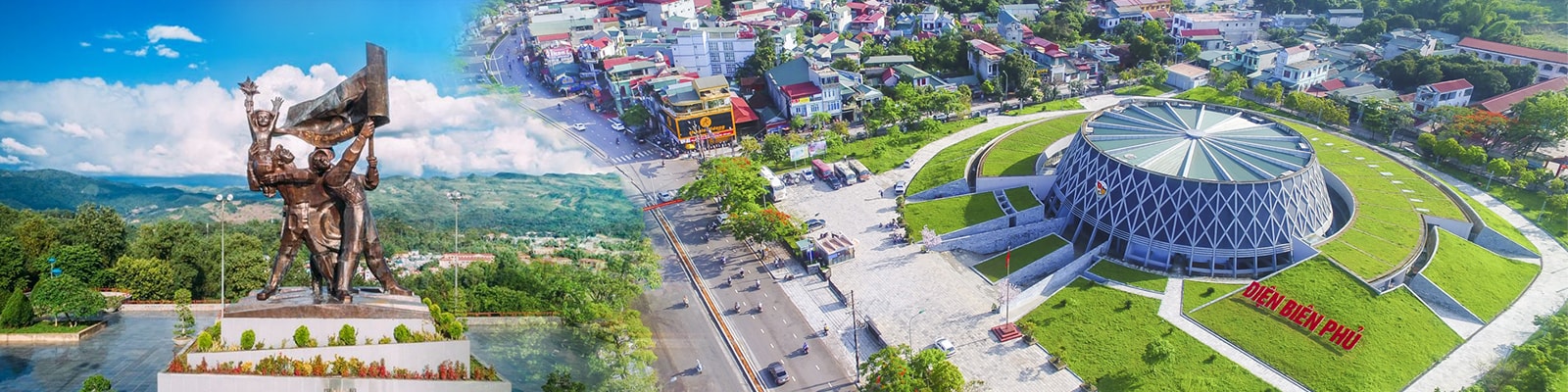
DIEN BIEN POTENTIAL & INVESTMENT OPPORTUNITIES
I. OVERVIEW OF DIEN BIEN
Dien Bien is a mountainous border province in the Northwest region of the country, with a natural area of 9,539.92 km2. It has geographical coordinates 20°54' - 22°33' North latitude and 102°10' - 103°36' East longitude. It is located nearly 500 km west of Ha Noi capital, the East and Northeast borders Son La province, the North borders Lai Chau province, the Northwest borders Yunnan province (China), the West and Southwest borders the People's Democratic Republic Laos.
Dien Bien is the only province that shares a border with two countries, Laos and China, of more than 455 km, of which: The border with Laos is 414,712 km; for China it is 40.86 km; There are many land border gates such as Tay Trang, Huoi Puoc - Na Son, A Pa Chai,..., forming the western gateway of the region and of Vietnam with ASEAN countries. Dien Bien is located in the Greater Mekong Subregion (GMS) cooperation space, so it holds a particularly important position for the Northern Midlands and Mountains region and the whole country in various fields including economy, culture, politics, national defense, and security.
Dien Bien has convenient transportation routes to the Northern provinces of Laos and Yunnan province of China, serving as the Northwest gateway for tourism in the Northern Midland and Mountainous region and Viet Nam. Dien Bien lies on important road traffic routes in the East-West direction (National Highways 6, 279); Northwest arc (National Highways 6, 12, 4D, 4H...).
Dien Bien Airport connects to two major economic centers of the country, Hanoi (nearly 1 hour flight) and Ho Chi Minh City (over 2 hours flight). The province is also upgrading and expanding Dien Bien Phu Airport to connect with other domestic and international flights in the near future.

Dien Bien Phu city.
Regarding Tourism, thanks to its strategic geo-economic location, Dien Bien tourism is located on important national tourism corridors:
- Northern arc: Hanoi - Hoa Binh - Son La - Dien Bien - Lai Chau - Lao Cai - through the Northeast provinces.
- East - West Corridor, Along Highway 279: Dien Bien - Lao Cai - Yen Bai - Tuyen Quang - Bac Can - Thai Nguyen - Bac Giang - Quang Ninh.
- Central corridor: Hanoi - Dien Bien - Vientiane (Lao PDR) along National Highway 6 and National Highway 279 (AH13).
- West - North Corridor: Phongsaly - Oudomxay - Luang Prabang (Lao PDR) - Dien Bien Phu - Muong Cha - Muong Nhe - Yunnan (China).
This is also an area with outstanding potential for eco-tourism, cultural tourism, cultural-historical tourism and border tourism.
Regarding Tourism, thanks to its strategic geo-economic location, Dien Bien tourism is located on important national tourism corridors:
- Northern Arc: Ha Noi – Hoa Binh – Son La – Dien Bien- Lai Chau – Lao Cai - through the Northeastern provinces.
- East-West Corridor, along National Highway 279: Dien Bien – Lao Cai – Yen Bai – Tuyen Quang – Bac Can – Thai Nguyen – Bac Giang – Quang Ninh
- Central Corridor: Ha Noi – Dien Bien - Vientiane (Laos) along National Highway 6 and National Highway 279 (AH13).
- Northwest Corridor: Phongsaly - Oudomxay- Luang Prabang (Laos) – Dien Bien Phu – Muong Cha – Muong Nhe - Yunnan (China).
This area also has significant potential for eco-tourism, cultural tourism, historical-cultural tourism, and border tourism.
Dien Bien Province has 10 administrative units at the district level with a population of over 646,000 people, including Dien Bien Phu City; 1 town (Muong Lay) and 8 districts (Dien Bien, Dien Bien Dong, Tua Chua, Tuan Giao, Muong Cha, Muong Ang, Nam Po, Muong Nhe), consisting of 19 ethnic groups living together. Among them, the Hmong ethnic group accounts for approximately 38.12%, the Thai ethnic group 35.69%, the Kinh ethnic group 17.38%, the rest are other ethnic groups.
Dien Bien province's human resources are quite abundant, the proportion of the population in the working age accounts for nearly 58% of the population. Dien Bien's labor force has a tradition of diligence and hard work, and receives attention and support for development, gradually meeting the requirements of high-quality human resources, serving the goal of industrialization and modernization of the country. The proportion of trained workers accounts for more than 62% of the total number of workers. The province has 4 colleges (Education, Economics - Technical, Health, Vocational) with a training scale of over 15,000 people.
Total product in the province GRDP 2023 reaches 14,912.29 billion VND, an increase of 7.10% compared to 2022, GRDP per capita (current price) is estimated to reach 42.98 million VND/person/year, an increase of 8 .6% compared to implementation in 2022, reaching 93.67% of the plan.
The economic structure has fundamentally shifted in accordance with the planned orientation for the 2021-2025 period: The agriculture, forestry and fishery sector accounts for 15.6%, down 1.06%; Industry - construction accounted for 22.25%, an increase of 0.97%; services accounted for 57.7%, down 0.03%; Product tax minus subsidies accounts for 4.45%, an increase of 0.03% (compared to 2022).
The agricultural and forestry production sector is restructured in the direction of improving productivity, quality and efficiency with the participation of businesses in a linked model, linking production with processing and product consumption; Up to now, there have been 54 products certified to meet OCOP standards (of which, 02 products rated 4 stars and 52 products rated 3 stars), typically specialty rice, rubber, coffee, tea... Gradually build a brand in the domestic market; The growth rate of industrial production is maintained on the basis of effectively exploiting the potential of electricity production, construction materials and processing industry; The service sector is developing rapidly. Total retail sales of goods reached nearly 20,000 billion VND.
Dien Bien is famous for the historical site of the Dien Bien Phu battlefield, which has been ranked as a Special National Relic by the Prime Minister, and some scenic spots ranked as national relics such as: Xa Nhe Cave; Huoi Cang Cave, Huoi Dap Cave; Tham Khen Cave...
From 2016-2020, the province welcomed over 3 million tourists, with an average growth rate of 12% per year.
The mobile information network and Internet have covered 100% of communes in the entire province. Passenger and goods transport activities develop stably, 100% of communes have car roads all the way to the commune center.
Import-export activities through border gates in the area are gradually being exploited, the export turnover of goods reaches nearly 80 million USD, the import turnover is over 35 million USD.
The province's total social investment capital reached nearly 18,000 billion VND, of which the contribution of the non-state sector was over 9,000 billion VND. Total state budget revenue is over 12,000 billion VND per year.
Political security, order and social safety in the province are guaranteed; the people of all ethnic groups are united in building the province's development.
II. MAJOR POTENTIAL ADVANTAGES OF DIEN BIEN PROVINCE
1. POTENTIAL FOR TOURISM
As a province with great potential and advantages to develop tourism with various forms such as: Historical, cultural, ecological and landscape tourism, the notable special national-level historical relic complex of Dien Bien Phu Battlefield has been interested in restoring, embellishing and promoting its values in recent years in accordance with the scheme approved by the Politburo.
In 2021, the whole work of Dien Bien Phu Historical Victory Museum has been completed with an oil-painted Panorama with an area of 3,250 m2, which is the largest monumental historical painting in Asia.
Through the language of painting, sculpture and installation with 4 scenes: All the people went to war; The majestic prelude; The historical confrontation and The Dien Bien victory, it has vividly recreated the whole 56 days and nights of the historical Dien Bien Phu Campaign.
In addition, Dien Bien also has many historical relics associated with the national construction and defense of the country, which are valuable potentials to exploit and develop tourism services of the province.
The province has a rich natural ecosystem with scenic spots: Pa Khoang Lake, Muong Nhe nature reserve, Muong Phang forest; The cave complex is recognized as a national relic; the hot mineral springs of U Va and Hua Pe in Dien Bien District, Sang Village in Tuan Giao District, Son La hydroelectric lake bed, and the westernmost landmark of A Pa Chai – the only place most adjacent to all 3 countries of Vietnam – China – Laos …
Dien Bien has a community of 19 ethnic minorities living together. Each ethnic group has its own unique cultural features, which have been preserved and maintained over the years, gradually exploited for the development of tourism services.
1.1. Natural Tourism Potential
With diverse terrain and natural advantages of many beautiful, magnificent, and poetic landscapes, Dien Bien has a rich and attractive natural tourism potential, providing a basis for developing various types of tourism such as eco-tourism, leisure tourism, adventure sports tourism,...
In the system of scenic spots in Dien Bien, we must mention Pa Khoang lake and Muong Phang natural forest (Muong Phang commune, Dien Bien district), UVa mineral water (Noong Luong commune, Dien Bien district), the scenery along the Da River (Muong Lay town), Muong Nhe nature reserve (Muong Nhe district), Pa Thom cave (Pa Thom commune, Dien Bien district), Noong U natural lake (Dien Bien Dong district), Tham Pua cave (Lung village, Tuan Giao district), Tham Khuong cave (Chieng Sinh commune, Tuan Giao district), Tham Vang cave (Bung Lao commune, Tuan Giao district), Pha Din pass...Specific assessment of some resource points Outstanding tourism of Dien Bien province is as follows:
Pa Khoang lake
Pa Khoang Lake is located in Muong Phang commune, Dien Bien district, next to National Highway 279, nearly 20km from Dien Bien Phu City and is a bridge connecting Dien Bien Phu with Muong Phang primeval forest, where Headquarters of Dien Bien Phu Campaign is located. The lake basin has a total area of 2,400 hectares, including 1,320 hectares of forest area, 300 hectares of agricultural land, 150 hectares of basic construction land, and 600 hectares of water surface (with a capacity of 37.2 million m3 of water), this complex has primeval forests, historical relics of Headquarters of Dien Bien Phu Campaign and a mountain lake.
Pa Khoang Lake is one of the valuable eco-tourism potentials not only of Dien Bien but also of national significance that needs to be exploited. The Pa Khoang lake area has many advantages for tourism activities such as: rich vegetation, diverse terrain, good climate suitable for relaxation.... In the surrounding forests, there are many animals and various types of orchids. Under the lake there are many species of fish and floating plants (about 65 species of floating plants, 14 species of floating animals, 6 species of benthic animals... have been counted). Pa Khoang Lake is located in the center of many mountains, in the middle of a majestic natural landscape, hidden in the clouds and water. In winter, mist covers the area, creating a magical landscape, looming in the distance with rolling mountains and lovely stilt houses. In the summer, the air here is very pleasant, with cool southern winds, so you can look out into the distance to see the clouds, sky, water, or take a boat trip and enjoy the scenery. All create a peaceful, poetic scene, a captivating landscape.
In addition, within the lake area, there are ethnic groups such as the Thai and Kho Mu who still preserve the unique customs and traditions of the Northwest ethnic groups... which serve as a fascinating cultural tourism resource.

Some images of Pa Khoang lake.
Pa Thom Cave
Pa Thom Cave is located in Pa Thom commune, situated in the western part of Dien Bien district, bordering the Vietnam - Laos border. Local people call the cave " Nang Tham Lai" which means the Full-of-Fairies Cave in Vietnamese language. The cave was discovered a long time ago along with beautiful legends and myths about romantic love.
Pa Thom Cave is not only a natural wonder but also a holy place in the belief of Dien Bien people. Located up high on the side of a mountain, the cave has a 12m high, 17m wide, arch-shaped mouth. At the middle of this special entrance stands a giant stone resembling the head of an elephant. Along the 350m length of the cave, there are 9 arches of different sizes. Impressive stones, stalactites, and stalagmites are ubiquitous. Right after you enter the cave, you will see a block of three huge stones that looks like a giant snake. Stalactites and stalagmites come in a variety of sizes and shapes, sparkling mysteriously under the candle light. The cave is extremely spacious. Decorated with majestic block of stones, the ceilings looks like that of a luxurious palace. The beautiful curtains made of soft-looking, colorful stalactites hang themselves beside the silver waterfalls inside the cave. In addition to its magnificent look, the local tales about love make Pa Thom Cave a romantic and attractive destination for travelers from everywhere.

Some images of Pa Thom Cave.
Uva hot mineral water
UVa hot mineral water is located in UVa village, Noong Luong commune, Dien Bien district, about 17 km south of Dien Bien Phu City. This is an easily accessible area and is located in the tourist resource system complex of Dien Bien district such as Hoang Cong Chat temple, Ban Phu citadel, Pa Thom cave...
The temperature of Uva hot water regularly reaches about 70 – 8000C. Currently, although there is no survey to specifically evaluate water quality, according to initial assessments, UVa hot water is capable of serving medical resorts. In addition, next to the hot water is UVa lake, about 9 hectares wide, which can be used to store water into an ecological and recreational lake. This can be considered a valuable natural and spiritual tourism resource for relaxation and medical treatment in the Dien Bien Phu area and surrounding areas.
UVa hot mineral water has been initially invested in building a medical resort and is attracting tourists. Besides cultural and historical tourism, UVa eco-tourism area contributes to diversifying tourism products and plays a satellite role for the tourism center of Dien Bien Phu City.

Some images of Uva Mineral Springs Resort.
Sang village hot mineral water
Sang village hot mineral water is located in Sang village, Quai Cang commune, Tuan Giao district, about 2.5km from Tuan Giao town along Highway 6 towards Muong Lay. This is a natural water source that forms a free-flowing complex with temperatures ranging from moderately hot to very hot (from 40 – 8000C at different locations. The water source is located in an area with attractive natural landscape including streams, rice fields, and hills of about 4 hectares, surrounded by Thai ethnic villages.
Local people often use bathing water on the 28th day of the 12th lunar month every year to wash away bad things and pray for good things in the new year. At the same time, the water is effective in treating skin diseases. Sang village's mineral water source has been around for a long time, but is still very wild and needs to be planned and invested in to develop into an eco-tourism and medical destination combined with visiting ethnic villages and entertainment... Currently Currently, this area has been planned by the People's Committee of Quai Cang district in detail as a basis for implementing investment projects in this area. This can be considered an attractive natural tourism resource point of Tuan Giao district in particular and Dien Bien province in general.

Some pictures of Sang village hot mineral water.
Landscape along Da River
If you start from Muong Lay town (the confluence of the Nam Na and Da rivers) and go downstream along the Da River to the east through Sin Ho district (in Lai Chau province) and Tua Chua district, or head west for a few dozen kilometers, you can admire the majestic landscapes, black stone roofs, and high mountain peaks touching the clouds. Along the riverbanks, there are still ethnic minority villages with houses peeking through the magnificent natural scenery. The river is always windy, making it an ideal place for river tourism on boats, where you can enjoy the scenery while listening to traditional Thai folk songs and savoring ethnic dishes. In the long run, after the construction of the Son La hydropower plant, with the water level rising to 215 meters, the area around Muong Lay town will turn into a vast reservoir, very favorable for developing various forms of lake ecotourism, becoming a unique tourist feature of the Northwestern mountainous region.

Some Images of the landscape along the Da River.
Muong Nhe Nature Reserve
Muong Nhe Nature Reserve is located in the communes of Muong Nhe, Muong Toong, Chung Chai, Ta Tong, Sin Thau… in Muong Nhe district (part of the former Muong Te district), about 100 kilometers northwest of Highway 12. With a natural area of 47,228 hectares at an elevation of over 1500 meters, the Muong Nhe Nature Reserve boasts a relatively rich flora and a variety of rare animals.

Some Images of Muong Nhe Nature Reserve.
Muong Phang - Pa Khoang Historical and Environmental Landscape Forest
The Historical and Environmental Landscape Forest Area of Muong Phang - Pa Khoang, located in Dien Bien district with an area of 4,436.6 hectares, features mountainous terrain with an average elevation of over 1,000 meters above sea level. To the east of the historical site area is a high mountain peak reaching 1,658 meters, the highest peak within the site's boundary with Dien Bien Dong district. To the west, the area has an elevation of less than 1,000 meters above sea level, where the artificial lake Pa Khoang spans approximately 700 hectares, with a water capacity of 37.2 million cubic meters, situated at an altitude of 900 meters. During the rainy season, water penetrates into small mountainous valleys, forming numerous small peninsulas, creating an attractive scenery for ecotourism, with water primarily supplied by the forests surrounding the historical site.
Muong Phang Historical Forest and the upstream forest area of Pa Khoang lake have high biodiversity, with 700 plant species belonging to four divisions of higher plants, and over 300 animal species across mammals, birds, reptiles, and amphibians. Additionally, the presence of Pa Khoang lake supports the thriving development of aquatic life.

Some Images of Muong Phang - Pa Khoang Historical Forest.
Noong U Natural Lake
Noong U lake is located in Tia Lo village, Pu Nhi commune, Dien Bien Dong district. This is a natural mountain lake. Although the lake is not large, its picturesque landscape and intriguing legends make it a potential site for ecotourism and sightseeing.

Some Images of Noong U Natural Lake.
Pha Din Pass
Pha Din Pass is located on National Highway 6 from Hanoi to Dien Bien, marking the boundary between the two provinces of Son La and Dien Bien. The pass stretches 32 kilometers and is known for its very rugged and precarious terrain. In the local language, "Pha Đin" means "Heaven and Earth." According to local legend, this is where Heaven and Earth meet. With an elevation of over 1,000 meters, the winding road ascends and descends steeply, with one side flanked by sheer cliffs and the other by deep abysses. The numerous treacherous curves create many spectacular viewpoints. Crossing Pha Din Pass is an exciting journey for travelers who wish to admire the majestic natural scenery. Additionally, this is a historic site associated with the glorious Dien Bien Phu Victory.

Some Images of Pha Din Pass.
Tham Vang Cave
Tham Vang Cave, located in Co Hom Village, Bung Lao Commune, Tuan Giao District, Dien Bien Province, is a limestone cave known for its natural and pristine beauty. The cave's interior is spacious and deep, nearly 100 meters high, with many branches. In the middle of the cave, there is a large flat rock resembling a table. Looking up at the cave walls and ceiling, you can see numerous stalagmites and stalactites forming shapes that resemble dragons, phoenixes, lions, kneeling elephants, or exquisite orchids. Tham Vang Cave is not only a beautiful cave but also an archaeological site. Local residents have discovered various stone tools here, such as axes and grinding pestles, along with some fossilized animal bones, which hold significant research value.

Some images of Tham Vang Cave.
In addition to the aforementioned prominent natural tourism resources, Dien Bien also boasts many hot springs, mineral water sources, specialties, and other natural landscapes that can be developed for tourism purposes. These include Tham Pua Cave (Nom Village, Chieng Sinh Commune), Tham Khuong Cave (Bo Village, Chieng Sinh Commune) in Tuan Giao District; Muong Thanh Field, Hua Pe Hot Spring in Dien Bien District; Pe Luong Lake and Huoi Pha Lake in Dien Bien Phu City, all of which have the potential to develop various forms of tourism such as sightseeing, relaxation, medical treatment, and health-enhancing activities for the public.
1.2. Cultural Tourism Potential
Cultural tourism resources include historical and cultural sites, revolutionary historical sites, traditional craft villages, and intangible cultural values such as folk arts and festivals. These elements showcase the diverse cultural identity of the ethnic groups in Dien Bien Province and attract tourists from both within and outside the country to visit, study, and explore. As the center of Northwest culture and a renowned site for the heroic Dien Bien Phu Victory, Dien Bien Province boasts a rich and appealing array of cultural tourism resources with high value for tourism activities. Among these, the following notable cultural resources are assessed to serve tourism:
Group of Revolutionary Historical Sites
Dien Bien's revolutionary historical sites are a key group of significant monuments for tourism development. These sites are primarily associated with the resistance against the French, such as the Dien Bien Phu Battlefield Complex; Pha Din Pass and the cluster of monuments in Pu Nhung Commune (Tuan Giao District), and Lai Chau Prison Monument (Muong Lay Town). Notably, the Dien Bien Phu Victory Monument Complex in the Muong Thanh Valley stands out.
The Dien Bien Phu Battlefield Monument is a place that commemorates the achievements of the Vietnamese People's Army during the Dien Bien Phu Campaign. This monument includes locations tied to the 56-day and night battle, where soldiers and civilians endured hardships, carving mountains and sleeping in trenches to achieve the “resounding victory of five continents, shaking the earth” that ended the prolonged resistance against French colonial invasion.
The Dien Bien Phu Battlefield Historical Site, located in the districts of Tuan Giao, Dien Bien, and Dien Bien Phu City, was one of the first ten special national monuments ranked in 2009, with 22 component sites. In 2015, the Prime Minister approved the addition of 23 more component sites, bringing the total number of recognized sites to 45, as follows:
Firstly, the sites related to the French colonial defensive battlefield (comprising 23 sites), which were our attack targets and bear marks of the heroic victories of our army. These notable sites include:
Relics of the stronghold group center (Muong Thanh): This was the highest concentration of forces and war equipment, including the Command Bunker of General De Castries, the Artillery Command Bunker of Piroth, artillery positions, tanks, Muong Thanh Airport, Muong Thanh Bridge, and several resistance centers to the east and west.
Defense strongholds: These were the outer defensive firepower points protecting the central subdivision. These strongholds were concentrated in two subdivisions: the Northern Subdivision (Him Lam, Independence, Ban Keo) and the Southern Subdivision (Hong Cum). Additionally, there were numerous strongholds within the central subdivision, such as the five eastern high points (A1, C1, C2, D1, E1).

Some images of the Dien Bien Phu Battlefield Historical Site.
Secondly, the sites associated with the Vietnam People's Army (comprising 22 points) are classified as follows:
Muong Phang Campaign Command Base: This was the campaign's command center from January 31, 1954, where all strategic decisions and battle plans were made until the victory day. This site includes the living and working quarters of the generals, the highest advisory bodies of the campaign command, and the Party Committee of the front. It also housed the local government operations (Resistance Administrative Committee). Currently, the living and working quarters of General Vo Nguyen Giap, Chief of Staff Hoang Van Thai, the General Staff, the Information Center, the Advisory Committee, the Combat Hall, the Mountain Tunnel, the Security Station, the Observation Post, and the Meeting Ground for declaring victory of the military branches have been preserved and reconstructed.
Campaign logistical sites: These were locations for gathering supplies and transporting weapons and ammunition for the campaign, such as Pha Din Pass, Tham Pua Cave, Tuan Giao Junction, and the hand-drawn artillery road.
Our army's attack positions: These include the 105mm artillery positions of Company 806, H6 artillery positions, the trench and tunnel system, the encirclement and assault positions, and more.
The Dien Bien Phu Battlefield Historical Site is one of Vietnam's most significant monuments, with the potential to develop into one of the most attractive cultural and historical experiential tourism destinations in Vietnam and on an international stature.
Group of Historical and Cultural Sites
The history of formation and development has endowed Dien Bien with many valuable historical and cultural sites for scientific research, education, and tourism. This borderland has witnessed many conflicts, and the historical sites mainly related to the Le and Nguyen dynasties, though few remain, are all valuable for research and tourism. Notable sites include Ban Phu Citadel and Hoang Cong Chat Temple, Tam Van Citadel in Dien Bien District, and Muong Luan Tower in Dien Bien Dong District.
Ban Phu Citadel and Hoang Cong Chat Temple
Ban Phu Citadel and Hoang Cong Chat Temple are located in Ban Phu, Dien Bien District, about 7 kilometers southwest of Dien Bien Phu City. This is a remarkable feat of construction by the Hoang family. The citadel covers over 80 hectares, with the Nam Rom River behind it. The walls of the citadel were made of earth and planted with bamboo brought from the lowlands. Outside, there was a deep moat 4-5 meters wide, and the top of the wall was wide enough for horses and elephants to walk. The citadel had four gates: front, rear, left, and right, each with a high watchtower and guard post. Remnants of the military barracks, weapon warehouses, and stables for horses and elephants still exist. The construction of the citadel was undertaken by Hoang Cong Toan, Hoang Cong Chat's son, from 1758 to 1762.
Hoang Cong Chat Temple was built in the center of Chieng Le Citadel (Ban Phu) to honor the Hoang family and six leaders of the insurgent army. This historical and cultural site commemorates the great contributions of leader Hoang Cong Chat, a native of Thai Binh, in the liberation war of Dien Bien. Additionally, the temple serves as a place of worship for the local people during the full moon, the Lunar New Year, and especially during the traditional festival on the 24th and 25th of the second lunar month each year. With proper investment, this site could become a cultural and spiritual tourism destination for both locals and tourists.

Some images of Ban Phu Citadel and Hoang Cong Chat Temple.
Tam Van Citadel
Tam Van Citadel, also known as Sam Mun Citadel (in Thai language), is located south of the Muong Thanh Field in Dien Bien District, more than 10 kilometers from Dien Bien Phu City. The citadel was built around the 10th or 11th century during the Le So Dynasty and served as an economic, political, and cultural center, as well as a stronghold in the Northwest during the efforts to protect the country against foreign invaders.
According to historical records, Tam Van Citadel was vast in scale (occupying an area equivalent to one-fifth of Muong Thanh Field). In front of the citadel, there were two fortifications, each 3 kilometers long and taller than a person. The fortifications were planted with bamboo in front and had deep moats in front of them. The inner citadel spanned tens of square kilometers, encompassing several communes, with Sam Mun as the center today. In the middle of the citadel were three mountains: Nang Non, Tao Non - Pu Huoi Chon, and Uva Lake.
According to the "Hung Hoa Chronicles," it is said that the citadel housed about 30,000 residents and 30,000 water-powered rice pounders. Scattered outside the citadel were villages of the Lu and Thai people, and further away were the villages of the Mang, Cong, Khang, and Ha Nhi people.
Today, the remnants of the citadel still exist, serving as a cultural and historical tourism resource for visitors to explore and learn about. However, the site is currently facing erosion and the natural landscape is being disrupted, necessitating solutions to preserve the relics.

Some images of Tam Van citadel relics.
Muong Luan Tower

Muong Luan Tower.
Muong Luan Tower is located in Muong Luan Commune, Dien Bien Dong District. It was built in the 16th century by the Vietnamese and Lao ethnic groups. This architectural artwork holds significant value for sightseeing and research. Currently, accessing Muong Luan Tower is still challenging, but in the long term, it will become an essential stop in the cultural exploration journeys of tourists studying the ethnic groups of the Northwest.
Group of Archaeological Sites
As a land with many caves, Dien Bien retains numerous relics that evidence the civilization of ancient Vietnamese people. Scientists have discovered many archaeological sites in Dien Bien, such as Tham Pua Cave and Tham Vang Cave (in Bung Lao); Tham Khuong Cave (in Chieng Sinh) of Tuan Giao District, where tools from the Old Stone Age, Middle Stone Age, and New Stone Age have been found. Additionally, scientists have discovered bronze tools from the Dong Son culture of the Hung Kings era, such as the Tuan Giao bronze drum (Tuan Giao District), Muong Thanh bronze drum, Na Ngum bronze drum (Dien Bien District), and Chieng Nua bronze drum (Muong Cha District). The system of archaeological sites in Dien Bien holds significant historical and cultural value and attracts tourists for sightseeing, exploration, and research.
Commemorative Ceremonies and Traditional Festivals
Dien Bien is home to 19 ethnic groups, including the Thai, Hmong, Kinh, Dao, Kho Mu, Ha Nhi, Giay, and La Hu. Each ethnic group has its own unique language, customs, and culture, creating a diverse cultural tapestry for Dien Bien. The cultural traditions of the ethnic groups living in Dien Bien are rich and deeply rooted in folk heritage, expressed through festivals - a distinctive cultural activity reflecting the spiritual life of the local ethnic groups - that have high potential to attract tourists. Some of the prominent festivals in Dien Bien include:
Dien Bien Phu Victory Anniversary (May 7, 1954): This is the most significant and important festival in the province, with profound national and international meaning. It is celebrated annually on May 7. Especially in milestone years, the Dien Bien Phu Victory Day is commemorated with grand celebrations and many meaningful activities. In 2024, Dien Bien Province will commemorate the 70th anniversary of the Dien Bien Phu Victory (May 7, 1954 - May 7, 2024).
Ban Phu Citadel Festival: This major festival of the ethnic groups in Dien Bien honors the great contributions of insurgent leader Hoang Cong Chat in the first liberation of Dien Bien in the 17th century. The festival is held annually on the 24th and 25th of the second lunar month in Ban Phu, featuring ceremonial rites, cultural festivities, ethnic culinary culture, traditional dances and songs, sports performances, and various other local cultural activities that attract tourists.
Tung Con Festival: A distinctive cultural activity of the young Thai men and women in Dien Bien, held annually in early spring. This festival is not only appealing due to the unique Thai culture but also because tourists can participate alongside the locals, making it a popular attraction for visitors today.

Images of Ban Phu Citadel Festival and Tung Con Festival.
Ban Flower Festival
The Ban Flower Festival is a prominent cultural event organized by Dien Bien Province in Dien Bien Phu City around mid-March every year. The festival aims to introduce, preserve, and promote various forms of ethnic cultural heritage in Dien Bien Province. It also seeks to link cultural preservation with tourism potential and economic development in the context of modernization, integration, and growth. Using the symbolic Ban flower as its central theme, the festival honors the Ban flower, representing the land and people of Dien Bien in particular and the Northwest region in general.

Dien Bien Ban Flower Festival.
Additionally, the province hosts various other festivals, such as the Xoe Flower Dance Festival and the New Rice Festival of the Thai people, which are significant for exploring and researching the cultural identity of the ethnic groups in Northwest Vietnam. Notably, the Thai Xoe Dance, recognized by UNESCO as an intangible cultural heritage, and the practice of Then by the Tay, Nung, and Thai people in Vietnam, which is being submitted for UNESCO recognition as an intangible cultural heritage, are highlights.
Other Cultural Tourism Potentials
The ethnic groups living together in Dien Bien each have their own cultural identity, expressed through traditional crafts, folk songs, and dances, making them an attractive tourism resource for research and exploration:
The sweet love songs, flute dances, bamboo dances, and xoe flower dances of the Thai people, combined with gong dances, are symbols of the cultural identity of the Northwest region, developed in each village in Dien Bien. The xoe flower dance is a common cultural activity of the Thai people in Dien Bien. It is a form of collective dancing and singing, where people hold hands and dance in a closed circle to the rhythmic sounds of drums and gongs, creating a mesmerizing and beautiful performance.
Traditional crafts, such as brocade weaving with intricate mountain forest patterns, leave a strong impression on both domestic and international visitors. This craft is mainly concentrated in Dien Bien District.
Natural products like honey, chit wine, and various types of rice such as black sticky rice, fragrant sticky rice, and white rice from the Muong Thanh fields, combined with the skilled hands of Dien Bien residents, create delicious dishes that reflect the daily life of the local ethnic groups. Some notable dishes include Buffalo bacon, Grilled chicken with Mac Khen, Pa Pinh Top (grilled fish), braised duck with banana flowers, ground pork steamed in banana leaves, rock moss, Cham cheo (traditional spices of the Thai people in the Northwest region) and Thai hotpot. These dishes are not only for tourists to enjoy but also for them to explore the unique culinary culture of the Northwest people. In addition, Dien Bien is also an area with a tradition of national sports such as Throwing a sacred ball through the ring (Nem còn): Spinning tops (Con Quay), Wrestling (Đấu vật), Crossbow shooting (Bắn nỏ)…

Some Images of Dien Bien Specialties.
Based on the analysis of roles, positions, and tourism potential, the prominent tourism potentials of Dien Bien are as follows:
The gateway location in the northwest of Vietnam, bordering China and Laos, has a border gate system with the potential to develop border tourism, notably A Pa Chai - the border gate of 3 countries.
The majestic mountain complex and rugged terrain create rich and diverse landscapes, which are ideal conditions for developing eco-tourism areas and destinations, and some outstanding tourist resource spots such as: Pa Khoang Lake; Pa Thom Cave; Uva Hot Spring; Muong Nhe Nature Reserve; Muong Toong, and Pha Din Pass.
Cultural identity of the ethnic groups in the Northwestern mountainous region and the system of historical relics of the illustrious Dien Bien Phu Victory.
Thai Xoe art - recognized by UNESCO as an intangible cultural heritage.
The heritage "Then Practices of the Tay, Nung, and Thai people in Vietnam" - is being submitted to UNESCO for recognition as an intangible cultural heritage.
Development Orientation of Tourism Space and Products:
Tourism Development Centers: The city of Dien Bien Phu, Dien Bien District, Muong Ang District, Tuan Giao District, Muong Lay Town, and Tua Chua District are the tourism centers of the province. The Dien Bien Phu tourism center is a crucial stop in the Northwest tourism corridor and adjacent regions domestically and internationally, serving as the hub for all intra-provincial tourism activities.
Favorable Tourism Development Space: The favorable tourism development corridors in Dien Bien Province are the corridors connecting key tourism centers or areas with concentrated resources along national highways 6, 12, and 279. Dien Bien tourism considers the space corridor from the Vietnam-Laos border gate (Tay Trang) through Dien Bien Phu City along national highways 12 and 4D to Lao Cai, and the tourism space corridor from Dien Bien Phu City along national highway 279 through Tuan Giao to Pha Din Pass and Son La as important, favorable tourism development spaces.
Priority Tourism Development Areas: Dien Bien Province identifies priority tourism development areas concentrated in Dien Bien Phu City, Dien Bien District, Tua Chua District, Muong Nhe District, Tuan Giao Town, and Muong Lay Town.
Development of Tourism Centers:
Dien Bien Phu City: A crucial stop in the Northwest tourism corridor and adjacent regions domestically and internationally, serving as the hub for all intra-provincial tourism activities. Main tourism products include: historical tourism (the Dien Bien Phu battlefield national special relic), cultural tourism, eco-tourism, MICE tourism, craft village tourism, and leisure tourism (hot mineral springs, caves).
The province's border tourism center focuses on developing the Vietnam - Laos - China border junction and the A Pa Chai border gate area in Muong Nhe district with cultural and border tourism products (westernmost point, border junction, border market) and border trade services,...
Dien Bien District: Tourism center associated with Dien Bien Phu city, with cultural tourism products, eco-tourism, resorts (hot mineral water, caves), spiritual tourism, agricultural tourism, Community-based tourism, and Craft village tourism.
Muong Ang District, focusing on exploiting the cultural - spiritual space (spiritual cultural tourism area in the rocky mountain area of Tang Quai pass, Tin Toc village, Ang Nua commune); Exploiting natural resources in the landscape of Ang Cang lake combined with community based tourism in Manh Danh village; Developing agricultural tourism (coffee agricultural tourism in Ang Nua commune, Muong Ang town; macadamia in Ngoi Cay commune, Muong Dang, high-tech fruit garden in Bung Lao commune; Phan Nhat tea... ); Encourage and utilize socialized resources to upgrade and develop eco-tourism models at Dao Vien Son tourist area, Ang To commune; Exploiting activities of visiting and exploring Tham Lom cave combined with shopping for local products (tea) in Xuan Lao commune.
Tuan Giao District is associated with the main tourism products of cultural - historical tourism (Special National Historical Relics of Dien Bien Phu Battlefield, Pu Nhung Revolutionary Base Area), eco-tourism, and resorts (hot mineral springs in Ban Sang, Quai Cang commune, Ha Cho cave, Mun Chung cave).
Muong Lay Town: Urban - Tourist service center of the Da River tourist route with products such as riverside resorts, riverside urban areas, sports, and river discovery center.
Tua Chua District: Developing types of eco-tourism, community tourism, agricultural tourism, cultural tourism...
Dynamic tourist areas:
- National Tourist Area Dien Bien Phu - Pa Khoang (Dien Bien Phu City): By 2025, the Dien Bien Phu - Pa Khoang Tourist Area is expected to meet the criteria of a national tourist area. This will be based on attracting investment, developing tourism products, and leveraging the heroic historical values of the Dien Bien Phu Battlefield National Historic Site. The development should align with the “Master Plan for the Development of Dien Bien Phu - Pa Khoang National Tourist Area, Dien Bien Province to 2020, with a Vision to 2030,” approved by the Prime Minister in Decision No. 1465/QĐ-TTg on August 24, 2015.
- National Tourist Area Tua Chua (Tua Chua District): By 2030, Tua Chua District aims to meet the criteria of a national tourist area by developing tourism infrastructure and unique tourism products that leverage natural and cultural resources. By 2040, it is expected to become a National Tourist Area with a synchronized tourism infrastructure system, attractive branded tourism products, and strong connections with Dien Bien Phu - Pa Khoang and other tourist areas in Dien Bien Province and the Northwest region, driving tourism and socio-economic development in Dien Bien Province.
- Hua Pe Hot Mineral Spring Tourist Area (Dien Bien District): Focused on wellness tourism, including hot mineral baths, etc.
- Sang Village Hot Spring Tourist Area (Tuan Giao District):
- Muong Nhe Nature Reserve (Muong Nhe District):
- Muong Phang - Pa Khoang Historical and Environmental Landscape Forest (Dien Bien Phu City):
- Tong Lenh Lake Ecotourism Area; Song Da Reservoir Ecotourism Area; Ta Phin Stone Plateau Tourist Area (Tua Chua District):
- Huoi Cang - Huoi Dap and Hat Chuong Cave Ecotourism Area (Muong Cha District):
- Muong Luan Resort Ecotourism Area (Dien Bien Dong District):
- Prominent Tourist Spots:By 2030, at least 10 tourist spots are expected to be recognized, including:
- Phieng Loi Village, Thanh Minh Commune, Dien Bien Phu City;
- Noong U Lake, Tia Lo B Village, Noong U Commune, Dien Bien Dong District;
- U Va Hot Mineral Spring, Group 17, Noong Luong Commune, Dien Bien District;
- Pha Din Pass Tourist Spot, Toa Tinh Commune, Tuan Giao District;
- Rose Valley Tourist Spot, Thanh Hung Commune, Dien Bien District;
- Muong Ang Coffee Agricultural Tourism Spot, Ang Nua Commune, Ang Cang Commune, Ang To Commune, Muong Ang Town, Muong Ang District;
- Che Can Village, Muong Phang Commune, Dien Bien District;
- Tua Chua Town Market;
- Na Su Village, Cha Nua Commune, Nam Po District;
- Ta Ko Khu Village, Sin Thau Commune, Muong Nhe District;
By 2050, at least 30 more tourist spots in the province are expected to be recognized, with continuous improvements in the quality of the already recognized spots.
Additionally, the province has other tourist attractions that need infrastructure and facilities to enhance accessibility for tourists, such as:
- Ban Phu Citadel and Hoang Cong Chat Temple (Dien Bien District);
- Three-tier Waterfall (Si Pa Phin Commune, Nam Po District);
- Ha Cho Cave, Pu Nhung Revolutionary Base (Tuan Giao District);
- Tham Lom Cave (Xuan Lao Commune, Muong Ang District);
- Tay Trang International Border Gate, Huoi Puoc - Na Son, A Pa Chai; Pha Din Pass (Tuan Giao);
- Muong Luan Tower, Chieng So Tower (Dien Bien Dong);
- Pu Vap Historical Site (Muong Lay);
- Chua Ta Cave (Dien Bien District);
- Kho Chua La Cave, Pe Rang Ky, Xa Nhe Market, the weekend market, the night market in Tua Chua Town, Ta Sin Thang Market, Vietnamese Heritage Tree - Shan Tuyet ancient tea forest in Sin Chai Commune; Trung Thu Pine Forest, terraced fields system... (Tua Chua District);
- Cultural tourist villages such as: Pe Luong, Uva, Ten, Co My, Hoong Lech Cang, Men (Dien Bien District), Noong Bua, Noong Chun, Him Lam II (Dien Bien Phu City),...
2. EXPORT-IMPORT POTENTIAL
Dien Bien province has 3 border gates and 2 border crossings: Tay Trang International Border Gate, Huoi Puoc National Border Gate, Si Pa Phin Sub-Border Gate, Nam Dich Border Crossing (bordering Laos), and A Pa Chai Border Crossing (bordering China). Among them, Tay Trang Border Gate and Huoi Puoc National Border Gate have the capacity and functionality to control export activities.
Tay Trang and Huoi Puoc Border Gates are subject to border economic zone policies, ensuring good clearance capacity and meeting the demand for goods exported through the border gates.

Tay Trang International Border Gate.
Dien Bien province has a border market at the A Pa Chai three-way border crossing (Sin Thau commune, Muong Nhe district), bordering Laos and China. The market operates as a sessional market, with goods mainly being consumer products, items, and agro-forestry products cultivated, harvested, and produced by people on both sides of the border.
The export-import activities in the province at the border gates and crossings show good growth, initially exploiting and promoting the advantages of a border province. Export-import enterprises are developing, with exports gradually increasing annually. For example, cement produced in Dien Bien province has become a major export product to the markets of northern Laos. Additionally, border trade activities and the exchange and sale of goods across the border are developing as residents on both sides frequently visit each other, exchange, and trade goods through sub-border gates, small border gates, and border paths, gradually promoting trade relations between the two sides.
3. URBAN DEVELOPMENT POTENTIAL
Dien Bien Phu City is currently the only city in the Northwest mountainous region that has an airport with a 2,400-meter long and 45-meter wide runway, meeting technical standards for modern aircraft such as the A320 and A321, and it has convenient road systems. In the near future, the Government and Dien Bien province will implement several key projects in the province, such as the Northern Mountain Provinces Traffic Connection Project, National Highway 12 and National Highway 4D (Tay Trang Border Gate - Dien Bien Phu City - Muong Lay Town - Lao Cai) and National Highway 279 (Dien Bien Phu City - Tuan Giao - Pha Din Pass - Son La) connecting with Lai Chau, Lao Cai, and Son La provinces. Additionally, numerous industrial, commercial, and service development projects will significantly transform the population structure, land use structure, and enhance the quality of infrastructure. This will be one of the main factors accelerating the urbanization rate, facilitating the formation of an urban system and concentrated residential areas in the province, particularly in Dien Bien Phu City and district centers. Simultaneously, the existing old urban areas will be upgraded and renovated to meet the needs for residential land allocation, and new rural residential areas will be expanded and developed in the future. Moreover, along newly invested and constructed roads, new residential areas can be established for local people or relocated households.
With the goal of achieving a Class II urban standard by 2025, Dien Bien Phu City has attracted potential investors such as Vingroup, Sun Group, Hai Phat, among others, to invest in projects within the area, focusing on commerce, services, and real estate. Urban development projects combine infrastructure architecture with the development of parks and green spaces, making the city not only more spacious and magnificent but also aiming towards a civilized, dynamic, and environmentally friendly urban area.
4. NATURAL RESOURCES AND ENVIRONMENT POTENTIAL
4.1 Land Resources
The total natural area of Dien Bien province is 956,290.37 hectares. Most of the land has steep slopes and thin cultivation layers. Due to the influence of various factors such as terrain, parent rock, climate, vegetation, and human production activities, various soil types have formed. These include alluvial soil, black soil, red-yellow soil, yellow-red humus soil on mountains, high mountain humus soil, and valley soil.
4.2 Water Resources
With a significant annual rainfall and numerous lakes, ponds, rivers, and streams (the province has more than 10 large lakes and over 1,000 rivers and streams distributed relatively evenly), Dien Bien boasts abundant surface water resources. The three main river systems are the Da River, Ma River, and Mekong River.
Da Rive: Located in the northern part of the province (bordering the newly established Lai Chau province), it originates from Yunnan (China), flows through Muong Te (Lai Chau province) - Muong Lay town - Tuan Giao, and then into Son La province. The Da River's main tributaries in Dien Bien include Nam Ma, Nam Bum, Nam Po, and Nam Muc, with a total basin area of approximately 5,300 km², accounting for 55% of the province's natural area.
Ma River System: Its main tributaries are the Nam Khoai River in Tuan Giao district and the Nam Ma River in Dien Bien district, with a basin area of 2,550 km². This is the second-largest river system in the province.
Mekong River System: It has a basin area of 1,650 km², with its main branches being the Nam Rom and Nam Nua rivers. The Nam Rom River originates in northern Dien Bien district, flows through Dien Bien Phu city - Pa Thom (Dien Bien district), and then into Laos. The Nam Nua River starts from Muong Nha, flows south-north, then east-west, and joins the Nam Rom River in Dien Bien basin before flowing into Laos. Common characteristics of the rivers and streams in the province are steep slopes and many rapids, especially those in the Da River and Nam Rom River systems.
4.3 Groundwater Resources
The dug wells have limited water, with the water level ranging from 2-4 meters below the surface. The closer to the mountain foothills, the deeper the water level. Recent drilling results by the Geological Team 63 indicate that the thickness of loose formations in the Muong Thanh valley is quite significant, reaching over 100 meters in many places. The drill holes yield large volumes of water (over 2 liters per second, with some reaching 5 liters per second) and the groundwater level is not far from the surface. The water is fresh and of good quality, and this aquifer is likely hydraulically connected to the Nam Rom river.
5. POTENTIAL FOREST RESOURCES AND BIODIVERSITY
5.1 Forest Resources
According to Report No. 5575/BC-UBND dated December 3, 2023, the current forestry land area is 419,757 hectares, with newly concentrated forest planting covering 1,551.81 hectares, including 132.66 hectares of protection and special-use forests and 1,419.15 hectares of production forests. The forest coverage rate is 44%. Dien Bien is a province with a large forest area. The development of the forest economy associated with the development of the forest product exploitation and processing industry, and the formation of forest product processing villages, is a potential advantage for the province, contributing to economic development.
5.2 Biodiversity Resources
Dien Bien province has a relatively diverse and abundant forest flora and fauna, with many rare and precious species. Vegetation: There are two main types: natural vegetation and planted vegetation.
Forest flora: There are 948 species, including 279 tree species (accounting for 29.4% of the total species), with 41 plant species listed in the Vietnam Red Book and the IUCN Red List. Among these are many valuable and economically significant timber species such as Chukrasia tabularis (Chò chỉ), Fokienia hodginsii (Pơmu), and Aquilaria spp. (Trầm hương). The shrub and bamboo ecosystems have a rich plant composition, with 405 species, including 3 rare species: Sarcandra glabra (Kim cang nhiều tán), Leptodermis balansae (Kim cang petelo), and Polygonum multiflorum (Hà thủ ô đỏ). The grassland ecosystem consists of 259 species, typically forming after forest fires or swidden agriculture, with main grasses belonging to the Poaceae family such as Imperata cylindrica (Cỏ tranh), Saccharum spp. (Lau), and Thysanolaena maxima (Đót).
Fauna: According to statistics, the province is home to about 400 vertebrate species, including 61 mammals, 270 birds, 27 amphibians, 25 reptiles, and 50 fish species. There are many rare animals, such as peafowl, leopards, gaur, white pheasants, mouse deer, rabbits, and muntjacs. In the Muong Nhe Nature Reserve, 27 orders, 95 families, and 133 forest animal species have been recorded, including 55 rare species such as the sun bear, Asian black bear, white-cheeked gibbon, langurs, monkeys, peafowls, and the great hornbill.
Birds and Reptiles: A total of 210 bird species belonging to 13 orders and 46 families have been recorded in the investigation.
6. POTENTIAL FOR AGRICULTURAL AND FORESTRY PRODUCTION
This province has significant land potential, with diverse and abundant climate and soil conditions, creating favorable conditions for the formation of specialized cultivation areas and the production of high-quality agricultural products. Efforts have been made to build brands and seek development opportunities in markets outside the province, such as Muong Ang district coffee, Muong Thanh field rice (which has registered a geographical indication), Tua Chua district Tuyet San tea, etc. There is still a large area of unused land suitable for livestock and forestry development, such as rubber trees, macadamia, palm, and timber materials. Particularly, the Muong Nhe Nature Reserve area, with a substantial remaining area of primary forest rich in flora and fauna, is a valuable resource for conservation and the establishment of a national park. These advantages can be leveraged to develop a diverse agricultural sector (agriculture, livestock, industrial crops, afforestation) with high quality associated with the processing industry.
Long-term Industrial Crops
Key industrial crops with substantial growth in productivity and output include rubber, macadamia, and tea. Numerous projects have been granted investment certificates, and supportive policies have been implemented quite comprehensively, contributing to encouraging residents and businesses to boost production investment.
Tea
By 2023, the total area of tea cultivation is estimated to reach 612.89 hectares, achieving 100% of the plan; the output of fresh buds is estimated at 164.00 tons, an increase of 43.95 tons compared to 2022, reaching 126.15% of the plan. Since 2019, 70 hectares of tea have been certified organic, with an estimated annual output of 24 tons of dry tea, mainly concentrated in Tua Chua district.
Macadamia
Regarding the natural conditions of the province, the climate in some areas is suitable for macadamia trees; however, only 25% of the land has a slope between 15 - 25 degrees. Land with a slope under 15 degrees accounts for only 4% of the province's land fund (approximately 38 thousand hectares), of which about 75% have a soil depth over 50 cm.
In terms of socio-economic conditions in areas where macadamia cultivation has been implemented (Dien Bien district - Phu Luong commune, Nam Po - Na Co Sa, Na Hy, Na Khoa, Nam Chua, Nam Nhu communes, Muong Nhe, and Tuan Giao), these areas are predominantly inhabited by the Thai ethnic group.

Macadamia in Tuan Giao District.
The total projected area for macadamia cultivation in the province by the end of 2023 is estimated to reach 2,436.39 hectares, bringing the total macadamia area in the province to 7,213.8 hectares. The area currently being harvested is approximately 1,000 hectares, with an output of about 714.4 tons, mainly concentrated in Tuan Giao, Dien Bien, Muong Nhe, and Dien Bien Dong districts.
Coffee
The area is 2,758.56 hectares, an increase of 4.51% over the previous year, achieving 104.73% of the plan; the estimated harvest output (green coffee) is 4,393.00 tons, an increase of 354.33 tons compared to the previous year, reaching 141.25% of the plan. The coffee price continues to rise, positively improving the income and profits of producers.
The entire province has 40 hectares of coffee certified to HACCP standards, and 1,318.47 hectares of coffee certified to UTZ standards (40.8%). The largest coffee growing area is concentrated in Muong Ang district.
Group of Grain Crops: Rice, Corn
Rice
In 2023, the total area of rice cultivation is estimated to reach 55,615.72 hectares, including:
- Winter-spring rice: The cultivated area is estimated to reach 9,913.68 hectares, an increase of 137.67 hectares compared to the previous year, achieving 102.35% of the plan; the estimated output is 60,984.15 tons, an increase of 2,040.95 tons, achieving 104.24% of the annual plan.
- Summer-autumn rice: The cultivated area is estimated to reach 20,994.31 hectares, an increase of 276.87 hectares compared to the previous year, achieving 101.23% of the plan; the estimated output is 113,790.69 tons, achieving 102.17% of the plan.
- Upland rice: The cultivated area is estimated to reach 24,707.73 hectares, achieving 102.82% of the plan; the estimated output is 36,713.39 tons, achieving 103.44% of the plan.
Approximately 20% of the total output is sold outside the province, mainly high-quality rice varieties such as IR64, Bac Thom No. 7, Seng Cu, Hana112, etc.
When mentioning Dien Bien's specialized rice-growing land, one cannot overlook the Muong Thanh field. The vast Muong Thanh field lies beside the Nam Rom River, which is always full of alluvium, in the famous Dien Bien basin. This is the largest plain amidst the mountains in the Northwest of Vietnam, with an old saying highlighting four fertile and top-quality rice granaries: "First Thanh (Muong Thanh - Dien Bien Phu), second Lo (Muong Lo - Yen Bai), third Than (Muong Than - Lai Chau), and fourth Tac (Muong Tac - Son La)."
In addition to the vast and fertile Muong Thanh field that provides two rice crops per year and is famous for its specialty Dien Bien rice, it is also essential to mention the Ta Leng terraced fields (now part of Thanh Minh commune). Terraced fields are a form of agricultural cultivation adapted to natural conditions. Spring is the time when a new crop begins; rice is sown and planted in the Ta Leng terraced fields, where water flows from high to low areas.
Corn
The cultivated area is estimated to reach 24,423.44 hectares, a decrease of 1,179.92 hectares compared to 2022, achieving 96.06% of the plan; the estimated output is 74,031.02 tons, a decrease of 2,245.62 tons compared to 2022, achieving 96.92% of the annual.
Key corn-growing areas have been established in Tuan Giao district, Tua Chua district, Dien Bien district, and Dien Bien Dong district, with a total area of over 9,000 hectares.
Other Annual Crops and Main Vegetables
- Cassava: The cultivated area reached 12,707.44 hectares, with an output of 123,504.92 tons.
- Peanuts: The cultivated area reached 1,147.26 hectares, with an output of 1,545.78 tons.
- Various vegetables: The cultivated area reached 4,938.03 hectares, with an output of 92,318.62 tons.
- Fruit trees: The current area reached 3,619.37 hectares, with an output of 22,598.86 tons, mainly including mango, orange, pomelo, banana, dragon fruit, longan, and lychee.
Experimental planting of green hemp is being conducted on some sloping land. In Dien Bien district, the first harvest of green hemp has yielded an average of 500kg - 600kg of bark per hectare.
Livestock
In 2023, the total number of livestock (buffaloes, cows, pigs) is estimated to reach 562,129, an increase of 2.51% compared to 2022, achieving 100.81% of the annual plan. Specifically:
- Buffaloes: The estimated number is 139,116, an increase of 1.92% compared to 2022, achieving 100.17% of the plan.
- Cows: The estimated number is 101,937, an increase of 3.80% compared to 2022, achieving 101.05% of the plan
- Pigs: The estimated number is 321,076, an increase of 2.36% compared to 2022, achieving 101.01% of the plan.
- Poultry: The estimated number is 4.817 million, an increase of 2.14% compared to 2022, achieving 99.92% of the plan. Disease control in livestock has been well managed.
Several concentrated livestock areas have been established, with farming conducted on family farms, industrial farms, and large-scale operations. High-tech farming models have initially been invested in, such as:
- The integrated livestock farm model following industrial methods in Thanh Hung commune, Dien Bien district
- The model of raising buffaloes and cows in family farms in Ma Thi Ho commune, Muong Cha district
- The large livestock farm model in Thanh Chan commune, Dien Bien distric.
- The Dien Bien livestock cooperative model established following biosecurity principles in Thanh Yen commune, Dien Bien district.
Fisheries
The aquaculture area is estimated to reach 2,761.58 hectares, an increase of 0.32% compared to 2022, achieving 100.14% of the plan. The estimated aquaculture production is 4,737.52 tons, an increase of 0.32% compared to the same period last year, achieving 100.14% of the annual plan. Efforts have been made to transfer scientific and technical knowledge, introducing economically valuable fish species for farming. Aquaculture is mainly concentrated in Dien Bien district.
Efforts are made to utilize the advantages of water surfaces from river, stream, pond, reservoir, and hydropower systems for aquaculture development, focusing on areas like the reservoir of Song Da hydropower, and large lakes such as Pa Khoang, Hong Khenh, and Na Huom. Steps are being taken to diversify species and farming methods to exploit advantages and meet market demand (traditional fish, monosex tilapia, cold-water fish like sturgeon and salmon). Currently, there are 11 effective aquaculture cooperatives in the province, with some cooperatives linking together for production and product consumption. Efforts to regenerate and develop aquatic resources and conserve indigenous aquatic species at risk of extinction are always prioritized.
The application of scientific and technological advances in aquaculture production is emphasized, with the implementation of technology in breeding and commercial farming of species like spotted catfish, rainbow trout in tanks, red tilapia, and sturgeon in floating cages, and monosex tilapia using Biofloc technology. These efforts aim to increase productivity and efficiency per unit area, attracting investment from some businesses in the aquaculture sector. Attracted a number of businesses to invest in the fisheries sector such as: Sturgeon and cold-water salmon farming project in Tenh Phong commune, Tuan Giao district; Raising fish in cages and rafts at Pa Khoang, Hong Khenh, and Pe Luong lakes.
Development of Medicinal Plants and Non-timber Forest Products
The province's rich forest vegetation provides a diverse range of non-timber forest products, including:
- Fiber-producing plants: rattan, bamboo (with approximately 533 hectares of tre, nứa forests, and 23,032 hectares of mixed wood-bamboo forests distributed across all districts, annually yielding thousands of tons of fresh bamboo shoots and various types of bamboo trees).
- Medicinal plants: Amomum, cardamom, Homalomena aromatica, Codonopsis, Fallopia multiflora, Dioscorea, Morinda officinalis, Achyranthes bidentata, Gynostemma pentaphyllum, chestnut, Zanthoxylum rhetsa (Northwest pepper), Chit flower, bamboo shoots, etc.
During 2016-2020, the province harvested significant quantities of various products, including 232 tons of pine resin, 70 tons of Stephania roots, 19 tons of Achyranthes bidentata roots, 289 tons of fresh bamboo shoots, 1,708 tons of fresh Cycas shoots, 2,514 tons of fresh chít flowers, 795 kilograms of Morinda officinalis stems, 733 tons of dong leaves, 20 tons of pine bark, 22 tons of Sterculia seeds, 26 tons of red fruits, 25 tons of Amomum, 68 tons of Radix 30 (Stephania), 190 tons of itchy roots, 40 tons of forest tea, 2 tons of land ginseng, 126 tons of Aristolochia, 2 tons of Alpinia seeds, 6 tons of Siegesbeckia, 1 ton of Codonopsis, 7 tons of Moutan seeds, 5 tons of chestnuts, and hundreds of thousands of bamboo trees of all kinds.
The province has issued a plan to develop areas for cultivating valuable medicinal plants, covering approximately 3,980 hectares at altitudes above 1,000 meters in Tuan Giao district. This includes over 1,740 hectares of forested land, nearly 1,490 hectares of non-forested land within forestry planning areas, and 750 hectares of other land.
The province organizes and implements projects or collaborates with residents through cooperatives and businesses in the form of linked projects for planting, caring, preliminary processing, processing, and product consumption.
7. Potential for Hydropower and Renewable Energy
7.1 Hydropower Potential
The potential for small hydropower depends on the distribution of the river and stream network, the flow distribution, and the topographic elevation differences. Within the territory of Dien Bien province, there are three main river systems: Da River, Ma River, and Mekong River. The Da River system within Dien Bien includes major tributaries such as Nam Ma, Nam Bum, Nam Po, Nam Muc, with a total basin area of approximately 5,300 km², accounting for 55% of the province's natural area. The Ma River system has major tributaries, including Nam Khoai River in Tuan Giao district and Nam Ma River in Dien Bien district, with a basin area of 2,550 km². The Mekong River system has a basin area of 1,650 km², with main branches including Nam Rom River and Nam Nua River. Nam Rom River originates in the north of Dien Bien district, flows through Dien Bien Phu city and Pa Thom (Dien Bien district) before flowing into Laos. Nam Nua River originates from Muong Nha, flows from north to south, then turns east to west and meets Nam Rom River in Dien Bien basin before flowing into Laos.
The common characteristics of the rivers and streams in the province are their steep slopes and many rapids, especially those in the Da River and Nam Rom River systems. Regarding the rainfall regime, Dien Bien, a province in the Northwest, experiences uneven spatial and temporal rainfall distribution due to its topographical conditions. Rainfall decreases from north to south and from east to west. Monthly rainfall distribution in Dien Bien is uneven throughout the year, forming distinct rainy and dry seasons. The rainy season usually lasts for five months from May to September, accounting for 75% to 80% of the annual rainfall. The dry season typically starts from October and ends in April the following year, accounting for 20% to 25% of the annual rainfall.
This significant technical potential allows Dien Bien province to develop medium and small hydropower projects, with a total projected capacity of 481 MW for the 2022-2035 period.
7.2 Wind Power Potential
Dien Bien is a mountainous border province in the northwest of Vietnam. The province has diverse topographies, mainly high mountains formed by ranges running in the northwest-southeast direction. The terrain tends to decrease in elevation from north to south and tilts from west to east. This topography provides Dien Bien with areas having very good and stable wind potential. According to the Global Wind Atlas, many areas in Dien Bien, located on high hills and mountains, have average wind speeds of 7.0 m/s to 10 m/s at a height of 100 meters and good wind density. This technical potential is favorable for developing wind power projects to supply electricity for the socio-economic development of Dien Bien province and the region.
The potential falls under mountain wind power projects, with mountain peak elevations ranging from 1050m to 1600m and valley elevations from 600m to 850m, with a relative elevation difference between peaks and valleys of about 200m to 500m. The mountain peaks are covered by lush vegetation, mainly shrubs and small timber forests. The proposed project areas are contiguous mountain ranges with slightly undulating peaks and minimal elevation differences, where wind turbines can be arranged along the mountainsides. Technical potential areas include:
- Mountain ranges in Keo Lom and Pu Nhi communes, Dien Bien Dong district (projected capacity 300MW to 500MW)
- Area in Noong U commune, Dien Bien Dong district (projected capacity 300MW to 500MW)
- Mountain ranges in the Tay Trang International border gate area, Na U and Pa Thom communes (projected capacity 300MW to 500MW)
- Mountain ranges in Muong Muon, Na Sang areas (projected capacity 300MW to 500MW)
- Mountain ranges in Tang Quai Pass area (projected capacity 300MW to 500MW)
- Mountain ranges in Muong Lay town area (projected capacity around 200MW)
- Mountain ranges in Pha Din Pass area, Quai To and Quai Cang communes, mountain range between Muong Mun communes (projected capacity around 200MW)
7.3 Solar Power Potential
According to the Vietnam Solar Radiation Map, Dien Bien belongs to the group of provinces with the fourth-highest daily radiation levels in the country, with 4.5 - 4.7 kWh/m²/day. It is one of the two provinces (along with Son La) with the highest daily radiation levels in the North. This is an advantage for the development of solar energy. The solar energy potential is analyzed and evaluated based on solar radiation measurement data, including direct, scattered, and total radiation, total radiation amount, and average daily and monthly sunshine hours. Statistics show that Dien Bien's solar energy potential can be applied at a medium level (medium level has 1,750 to 1,900 hours of sunshine; radiation 125-150 Kcal/cm²/year). This significant technical potential helps Dien Bien province leverage its advantage for electricity production development.
7.4 Pumped-Storage Hydropower
Dien Bien is a mountainous province with a complex terrain, high mountains that are divided, and riverbanks with steep slopes, forming small high-altitude valleys. These conditions are favorable for building reservoirs and developing pumped-storage hydropower, especially in areas around large hydropower reservoirs like Son La and Lai Chau. Areas suitable for pumped-storage hydropower development include Muong Lay town and Tua Chua district, near the Son La hydropower reservoir. Recent surveys by some investors indicate a total projected capacity of 3,200 MW.
The types of electricity production in the province with potential include small hydropower, solar power, waste-to-energy, biomass energy, and pumped-storage hydropower. Currently, the government is developing the National Power Development Plan for 2021-2030 with a vision to 2045 (Power Plan VIII). Dien Bien province has proposed to the Ministry of Industry and Trade to include the following in the plan, with a total projected capacity of 4,408 MW for 2021-2035:
- Rooftop solar: 100
- Ground-mounted solar: 500
- Floating solar: 100 MW
- Wind power: 1,430 MW
- Waste-to-energy: 5 MW
- Small hydropower: 481 MW
- Biomass: 72 MW
- Pumped-storage hydropower: 2,000 MW
8. Potential for Processing Industry
Currently, the province has two industrial clusters (ICs) with detailed planning: Na Hai IC in Dien Bien district and the East IC in Tuan Giao district. There is also a newly established IC: the Mixed IC in Muong Ang district. All three clusters have not been fully developed yet (investors are investing in their factory areas). Specifically:
- Na Hai IC: According to Decision No. 1282/2010/QD-UBND, it covers an area of 49.8 ha and mainly functions to produce construction materials and household goods. The current occupancy rate is 56%. Two enterprises are operating in the cluster: Dien Bien Cement Plant with a capacity of 360,000 tons/year and a standing brick factory with a capacity of 23 million bricks/year. The operation of Na Hai IC contributes approximately 4.13% to the total industrial production value and provides jobs for around 500 workers in the province.
- East IC of Tuan Giao district: According to Decision No. 954/2011/QD-UBND, it covers an area of 50.3 ha and mainly functions in food processing and mechanical repairs. The current occupancy rate is 12%, with one enterprise: a plywood and chipboard processing plant with a capacity of 13,500 m³/year and 36,000 m³/year respectively, which is currently temporarily closed.
- Mixed IC: According to Decision No. 585/2018/QD-UBND, it covers a planned area of 15 ha, mainly functioning in agricultural product processing, animal feed production, supporting industries from agricultural production, construction materials production, fertilizer production, and handicrafts. The current occupancy rate is 20%, with one enterprise: Viet Bac Coffee Co., Ltd., which is currently building a coffee processing plant on nearly 3 ha but has not yet made any contributions.
The main industrial sectors in the province include mineral extraction and processing, including the extraction of materials for construction, coal mining, and lead-zinc mining; agricultural product processing, food processing, and wood processing.
- Mineral Extraction Industry: Concentrated in Dien Bien Dong district, it includes 20 stone mining sites for construction materials with a total allowable extraction volume of over 18.2 million m³; 7 sand mining sites with a total licensed volume of 354,876.7 m³; 3 coal mining sites with a total allowable extraction volume of 351,416 tons; and 1 lead-zinc mining site with a total allowable extraction volume of 244,076 tons. There are 17 enterprises employing 875 workers, primarily engaged in coal and sand mining.
- Agricultural Product and Food Processing Industry: This sector has grown significantly from 2016 to 2020, attracting high-quality rice processing projects using automatic technology lines by Truong Huong Agricultural Seed Co., Ltd. in Dien Bien district, with a capacity of 3,000 tons/year and a total investment of about 15 billion VND; and a cassava starch factory with a capacity of 80 tons of dry starch/day, with a total investment of about 70 billion VND, currently under investment. This sector currently has 10 enterprises employing 63 workers, primarily processing rice, corn, cassava, and tea.
- Wood Processing Industry: The province has two industrial-scale wood processing plants: a bamboo plywood factory in Dien Bien district, with a capacity of 20,000 m³/year; and a finger-jointed board and chipboard factory by Viet Tay Bac Forest JSC in the East IC of Tuan Giao district, with a capacity of 13,500 m³/year (finger-jointed boards) and 36,000 m³/year (chipboard). This sector currently has 7 enterprises employing 102 workers, primarily processing sawn timber.
- Construction Materials Production Industry: Mainly concentrated in Dien Bien Phu city and Dien Bien district, this sector's products can largely meet the demand for some types of construction materials within the province, such as cement, building stone, bricks, and sand. Other types of materials (decoration, finishing, high-end materials) have to be supplied from outside the province. This sector currently has 12 enterprises employing 615 workers, primarily producing cement and fired clay bricks.
9. Investment Support Mechanisms and Policies
Dien Bien province will research and issue mechanisms and policies in various fields to attract more resources for development. Before issuance, these mechanisms and policies must undergo consultation and social criticism from associations, professional social organizations, and feedback from affected stakeholders to ensure practical implementation. The focus will be on researching and issuing specific mechanisms, policies, and regulations, including:
- Investment Support Policies: Policies such as land use fee exemption and reduction, corporate income tax reduction, and import tax reduction will be maximized according to the law for businesses investing in the province.
- Infrastructure Investment Support: Mechanisms and policies to support investment in transportation, electricity, water infrastructure, and related industrial clusters to attract synchronized and high-quality infrastructure investors, thereby enhancing the province's competitiveness and investment attraction.
- Attracting Major Investors: Mechanisms and policies to attract large investors, effective and sustainable investment projects to the province.
- Urban Development Policies: Developing mechanisms, policies, and regulations to mobilize and improve the quality of integrated, modern, green, and sustainable urban areas. This will create attraction, develop services, and foster a healthy real estate market.
- Startup and Innovation Support: Policies to support startups, innovation, modern technology updates, environmentally friendly technology and products, digital transformation, and digital economy. Also, support mechanisms for the development of small and medium-sized enterprises.
- Tourism and High-End Hotel Investment: Preferential policies and support for investors in tourism areas and high-end hotels through legal procedures support, compensation for site clearance, and investment in connecting transportation, electricity, and water infrastructure.
- High-Quality Agricultural Production Support: Policies to support and advise on high-quality agriculture and clean agriculture. Focus on supporting seeds, implementing high-tech applications in production, ensuring clean production standards according to VietGAP and GlobalGAP, improving processing stages, and promoting market linkages and output market searches.
- Attracting High-Quality Human Resources: Policies to attract and utilize high-quality human resources in state management, college lecturers, skilled doctors, science and technology personnel, engineers, and high-skilled workers in key sectors and products.
- Enhancing Legal Framework and State Management: Improving the quality of drafting, reviewing, systematizing legal normative documents, and enhancing the efficiency of state management in various sectors. Strengthening administrative violation management and handling, promoting law enforcement monitoring, especially in critical and prominent areas. Improving the effectiveness of state management in judicial and administrative support.
III. Key economic development orientations in the period up to 2025 with a vision to 2030
1. Concentrate investment resources to upgrade traffic infrastructure, with the main focus of:
Upgrade and expand Dien Bien Airport to meet 3C standards, receive Airbus A320 and Airbus A321 aircrafts in accordance with the investment policy approved by the Prime Minister, strive to start construction by the end of 2021 and complete to put into operation in 2023.
Focus on mobilizing resources to upgrade arterial traffic routes, with the focus of National Highway 6 and National Highway 279, intra-regional traffic routes in dynamic economic areas in the province.
The upgraded and invested key transport infrastructure will ensure Dien Bien to improve internal and external traffic conditions and enhance connectivity with major economic centers in the country and in the region by road and airline.
2. Concentrate on mobilizing resources to promote the development of large-scale concentrated and specialized agricultural production, associated with the development of product processing and consumption industry with teh participation of enterprises and concentration groups.
Focus on develop developing products of specialty rice, fruit trees, long-term industrial plants, medicinal plants and macadamia, increasing the output of high-quality agricultural products that have been recognized as meeting OCOP standards.
The province has given a policy on a mechanism for development cooperation with enterprises of the Vietnam Macadamia Association, agreeing on a roadmap to achieve the goal to make Dien Bien become the macadamia capital of the world in the period up to 2030 with the target of about 100 thousand hectares of new planting.
3. Promote the development of tourism services synchronously with the upgrading of Dien Bien Phu airport and external traffic routes, striving to make tourism a spearhead economic sector of the province by 2025 based on exploitation of 3 main pillars: Historical and spiritual tourism; Tourism of natural landscapes associated with understanding national cultural identity; and Tourism of entertainment, convalescence and sports.
In the past time, many reputable investors such as Vingroup, Hai Phat, Flamingo ... have signed agreements and proposed to construction of urban areas, trade centers, hotels, golf courses with Dien Bien Province to soon deploy in the near future.
4. Expand, develop and accelerate urbanization. Focus on urban expansion and development of Dien Bien Phu City with the oriention of renovating the existing Center into the Trading and Service Center. Build a new political and administrative center in the East, expand the urban functional subdivisions in the north in association with the expansion of land fund in urban areas, attracting investment in entertainment areas, hotels and resorts on the basis of exploiting diverse potential advantages in terms of terrain and land, striving to reach the criteria of second-grade urban area by 2025.
Dien Bien province, with the open investment attraction policies, Dien Bien will surely develop strongly in the future. We look forward to welcoming all visitors and investors to Dien Bien, to together experience and arouse the potentials and advantages of the province's tourism./.
Dienbien.gov.vn

