Sin Chai Commune: Aspiration to get rich from ancient tea trees
Ancient tea trees have been associated with the people of Sin Chai for generations. Through many ups and downs, the tea trees have remained green and continue to demonstrate their resilient vitality. Making use of the available advantages, local people have constantly innovated their production methods and invested in processing machinery to create high-quality finished tea products, thereby increasing value and income. The Sin Chai commune authorities have also developed specific plans and action programs to expand the tea-growing area and turn this specialty tea into a key commodity product.
Ancient tea forest in Hau Chua hamlet, Sin Chai commune.
Affirming Economic Value
From the center of Sin Chai commune, following a small road nestled between two steep cliffs, we arrived at Hau Chua hamlet – the “capital” of ancient tea trees in the commune. Even at 9 a.m., thick fog still covered the path. The deeper we went into the hamlet, the denser the fog became, limiting visibility. Although the distance was only about 8km, it took us nearly 40 minutes to reach the destination.
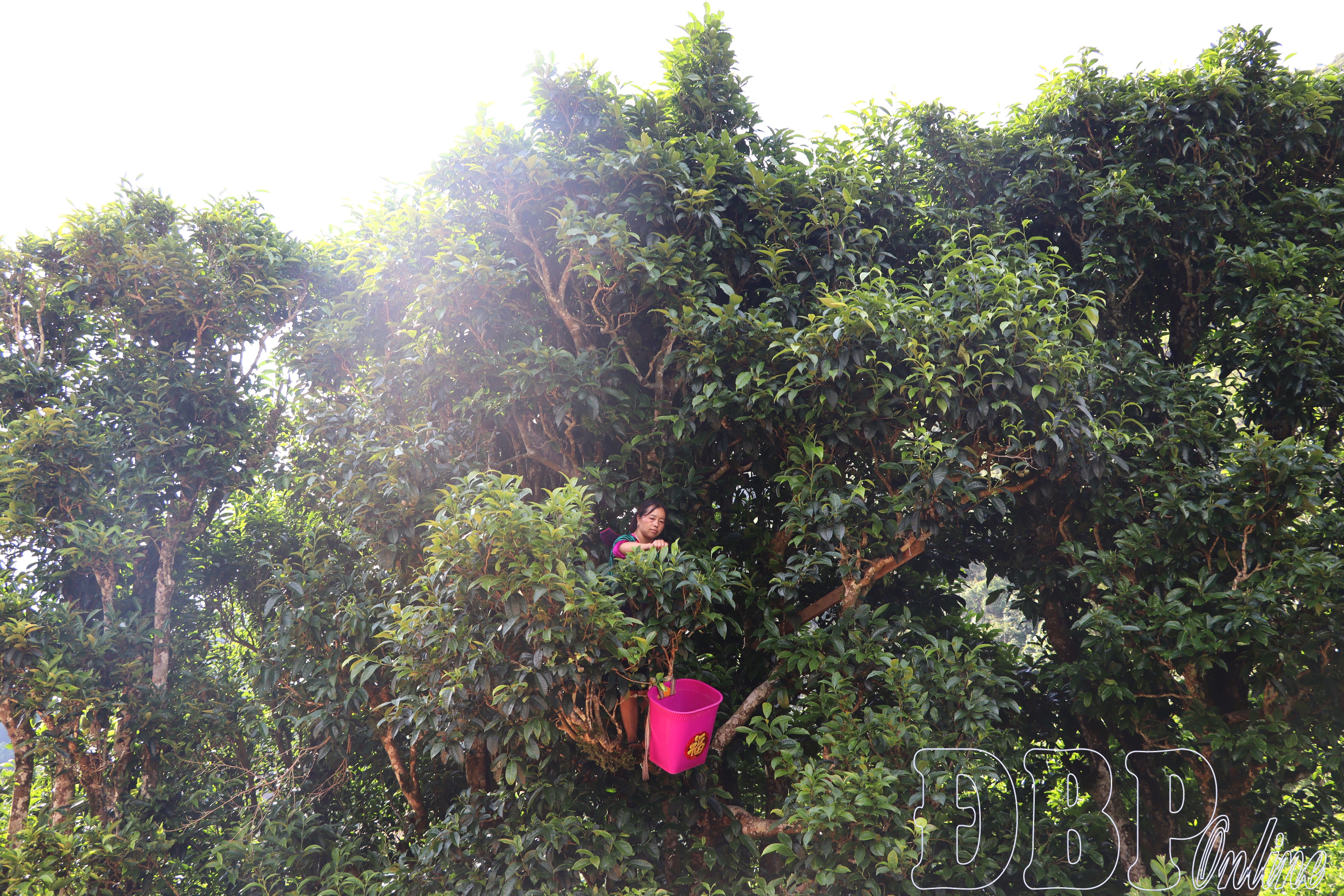
People in Hau Chua hamlet harvested ancient Shan Tuyet tea.
As arranged beforehand, we visited the house of Mr. Hang A Chu – the person who owns the largest number of ancient tea trees. He was already waiting with a pot of hot tea, its aroma spreading throughout the house. True to its reputation as the “capital” of ancient tea trees, around Mr. Chu’s house and the homes of other villagers, there were almost no other plants except tea trees. These ancient trees rose higher than the roofs of the houses, with trunks measuring 80–100cm in diameter, standing firmly as if embracing Hau Chua hamlet in endless green.
At over 70 years old, Mr. Hang A Chu remained healthy, alert, and energetic. While pouring hot tea for guests, he shared: “No one knows exactly when the ancient tea forest of Sin Chai began, but for generations people here have been closely attached to tea trees. In Hau Chua, almost every household has ancient tea trees, from a few dozen to several hundred. My family alone currently has more than 650 trees – the most in the commune.”
In the past, tea was mainly brewed for daily drinking. Since 2005, local people have started learning how to process tea for sale in the market, gradually turning tea into a commercial product.
Mr. Chu’s family was among the pioneers in commercializing tea production. At first, tea was processed manually. In 2008, after several trips to learn from other regions, he invested in machinery for large-scale processing. As a result, his family now supplies 200–300kg of dried tea to the market each year. By focusing on quality and packaging, the product has gradually increased in value, bringing in stable annual revenue of 200–300 million VND.
Mr. Chu said: “Compared with rice or corn, tea brings much higher economic value. Currently, 1kg of dried tea can sell for about 1 million VND, while one ton of corn sells for only around 3 million VND. Therefore, people actively take care of and protect these ancient tea trees, considering them a valuable asset that provides stable and long-term income.”
Mr. Mua A Chinh’s family in Sin Chai hamlet currently owns more than 100 ancient tea trees. In recent years, he has boldly invested in machinery to process finished tea products for the market. Besides processing tea from his own garden, he also buys raw tea leaves from other households in the hamlet, helping increase the value of tea and providing additional income for the community.
Mr. Chinh shared: “Growing tea is much easier than growing corn or rice. Tea only requires clearing weeds, harvesting, and processing, which reduces labor while providing more stable income.”
By the end of 2024, Sin Chai commune had more than 152 hectares of commercial tea with about 6,600 ancient tea trees. The average annual production reached 65 tons of fresh tea leaves, equivalent to about 13 tons of dried tea. Tea has clearly demonstrated its outstanding economic value and has become a key crop helping highland villages in Sin Chai escape poverty quickly and sustainably.
Toward Sustainable Development
After many years of working with ancient Shan Tuyet tea trees, Mr. Hang A Chu and several households in Sin Chai have had opportunities provided by the commune authorities and relevant departments to visit and learn about tea cultivation, processing, and preservation models in provinces such as Thai Nguyen and Phu Tho. After each trip, local people gained more knowledge and experience to apply to their production activities at home.
Mr. Chu said that when visiting famous tea regions such as Thai Nguyen and Phu Tho, he realized that Sin Chai’s tea production scale was still quite small. In his hometown, only a few thousand ancient tea trees are scattered across hamlets, while in those provinces tea plantations stretch across vast areas. In addition to large planting areas, these localities also have companies investing in modern processing factories with high capacity and closed production lines from raw materials to finished products with attractive packaging that meets export standards. As a result, some Thai Nguyen tea products can sell for up to 5 million VND per kilogram, significantly improving the livelihoods of tea farmers.
Each study trip to major tea-growing regions has motivated Mr. Hang A Chu and the people of Sin Chai to further develop their ancient tea forests.
Mr. Chu shared: “To develop like them, Sin Chai must first have a sufficiently large raw-material area. Only when the area expands will it attract businesses to invest.” Therefore, in recent years, he has actively propagated local tea varieties to expand the planting area and encouraged villagers to convert low-yield corn and rice fields into tea plantations. In the past two years alone, his family has planted an additional 1,600 tea trees.
Following the same direction, Mr. Mua A Chinh has also been striving to expand his tea cultivation area. From initially owning just over 100 tea trees, he has now built a concentrated 3-hectare plantation of local tea varieties, which has recently begun producing harvests.
Along with the efforts of local residents, the Party committees and authorities of Sin Chai commune have consistently identified tea as a key industrial crop with high economic value that helps residents escape poverty quickly and sustainably. At the First Congress of the Party Committee for the 2025–2030 term, the commune set a target of planting 10,000 new Shan Tuyet tea trees, gradually turning tea into the main agricultural product of the locality.
Sharing solutions for the sustainable development of Shan Tuyet tea, Mr. Thao A Lu, Vice Chairman of the People’s Committee of Sin Chai commune, said that the commune has developed projects to preserve existing ancient tea populations and propagate local Shan Tuyet tea varieties to both conserve valuable genetic resources and expand the planting area. The commune also promotes communication and training for farmers to apply organic and environmentally friendly farming methods, avoid chemical fertilizers and pesticides, and strengthen linkages for diversified processing to meet market demand.
Ancient tea trees continue to grow resiliently on rocky mountain slopes, serving as vivid evidence of the vitality of the people of Sin Chai and their determination to rise above hardships and fulfill their aspiration of becoming prosperous right on their homeland.
Leaving Sin Chai in the late afternoon, as the ancient tea trees gradually disappeared behind the mountain peaks, I still remembered the heartfelt words of Mr. Hang A Chu – a man who has devoted his life to the tea forest: “I only hope that one day Sin Chai tea will achieve success like famous tea products in Thai Nguyen and Phu Tho. I may not live long enough to see that day, but I hope the younger generations will continue to preserve and develop these ancient Shan Tuyet tea trees. I also hope that authorities at all levels will have specific and effective strategies so that our local tea products can develop sustainably and reach farther markets.”./.
Source: Dienbienphu Online

